Monday, 7 September 2015

So Long Sweet Summer

The days of bare legs and sunshine clothes are drawing to a close, as golden leaves and bonfire smoke are hot on their trail, carrying the promise of crunchiness underfoot and visible breath clouds on crisp mornings, in which I can pretend to be a dragon blowing puffs into the sky. I've held on to the dregs of 'beach season', when I only went to the beach once and that was in the rain, but now I'm ready to surrender to slippers, scarves and raking the garden, trying not to stumble into dew-decorated spiders' webs and hoping to goodness none of the spiders get inside my house. It's a vain hope of course; they always do.

Here is my bright yellow summer swan-song, shod in flimsy dampened suede, twirling away the rest of my summer dreams into autumn realities. In the twilight space between seasons the skies are capricious, and the garden teetering between lush and dank depending on the gifts they bestow. I don't venture onto the lawn barefoot anymore, and suspect that just as it's dry enough to be mown it will cease its growth spurt anyway, as if the onset of Autumn slows nature down. In reality it can seem the briefest season, easily blinked away between late summer warmth and early winter frosts - a season of hurried fire-coloured flurries, insistent winds that tug at reluctant branches, sudden sunsets and bright blue dawns.

While nature prepares to power down, shedding summer finery and drawing us into dreams of festivities now not so far off, I'm still getting into gear for the onward push. I've spent the summer planning and learning, growing, not an overnight shoot but a season-long slow burn that's pressed through the cracks in my experience. Leaving behind the summer is like leaving a training camp, hardened by testing and a little sore, but keen for the next assignment.

Autumn to me is like a Phoenix, blazing into flame knowing full well that a glorious rise from the ashes is just around the corner in Spring's swift bud. Autumn takes the year's cycle out in magnificent style, bold and effusive, unapologetically strong. Its winds may seem destructive, but Autumn understands that the cycle demands sacrifice: that nothing new can be created without the old making way for it. It works not on decimation but on renewal, as year on year old coats are shed and fresh life reaches higher, further than before. Autumn proudly shows its colours, fierce yet stately, and of a rare day quiet and still, inviting wonder. And, in its shining crown, Autumn brings the harvest.

Saturday, 5 September 2015

People in Need of Love

Here we go then: me and my laptop and my befuddled brain, typing out whatever occurs to me and hoping to goodness it makes some sense to someone. Because if there's anything I've learned this week/month/year, or rather re-learned, it's that I haven't got the answers. I really wish I did. Sometimes I probably act like I do. But I have to be honest - as much as I want to be of significance in this world and do something or things that are worthy and useful and giving, I frankly haven't got a clue how. All I know is that I see needs that I want to fulfil, and I along with the rest of humanity just have to do the best I can to do so. If I can be brave enough; if I can stop being selfish.

My title for this blog is sappy, I know, but there's a reason for that - it's the best summation of humanity and my approach to life that I can possibly come up with. I firmly believe that is exactly what we all are: people in need of love, and not just the romantic kind. I mean filial, brother-to-brother, sister-to-sister even when we are not family, even when we are separated by national or cultural boundaries. I mean parental, in the care and guidance given by a mother, a father, someone who fulfils that role and protects. I mean agape love, love at its ultimate, the love that is willing to sacrifice whatever it must for the best of others.

There are kinds of love in this world that are so often overlooked in pursuit of the emotional eros rush, or subdued for the simple fact that we've developed an awkwardness of expression that prevents us from engaging in anything that could cause us embarrassment. That compassion and care for our fellow-man is a kind of love that should be celebrated and freely expressed is buried under fear of offence, and the very real possibility of being made uncomfortable. Countless times I've kept my mouth firmly shut when I actually knew it was right to try and say something helpful, or check if someone was okay. Also numerous are the occasions on which a well-meaning word of encouragement from someone else has been rebuffed with the lie of 'I'm fine,' because I didn't know how to accept their kindness. The prospect of acknowledging need, and thereby weakness, has our hackles up.

As far as I see it, we've got a couple of problems, and the first is that we live in a society that doesn't tolerate what it perceives as weakness. This might seem contradictory, but please hear me out. Apart from being a child, is there any state of being that doesn't come in for ridicule and judgement from one significant party or another? Those who are less physically strong or able can be left out of sports and physical activities even in school; assumptions are made that they don't try hard enough, and those assumptions follow into adulthood. Those who struggle with academics, regardless of the teaching scenario, their personality type and best methods of learning etc, are labelled 'thick', 'stupid', 'a failure'. Those who carry extra weight, for whatever reason, are vilified for a lack of self control; assumptions are made that they are lazy. The young are dismissed for a lack of experience. The old are dismissed as out-of-date. Women are told they have equality with men but are discriminated against in work and society for having children, not having children, having a career as well, staying at home with kids, wearing certain clothes... Men are assumed to be bullish, brutish, unintelligent, incapable of doing more than one things at once, not a 'proper man' if they are short/unbearded/single/etc. We have labelled our differences as weaknesses, and frankly, there just is no safe ground - some sector of society will always be pulling down another. With this to contend with, is it any wonder we have learned to put up a front of 'I'm fine', and never admit we might be struggling and in need of help? Is it any wonder that we hesitate to offer help, in case we offend someone by implying that they can't cope? Is it any wonder that our best chance of securing love of any kind may seem to be altering the way we come across, our appearance or our personality?

The second problem is the barriers created by the categories we then file ourselves into in order to cope with this dog-eat-dog approach to life. I'm no psychologist and I have no provable theory on this, only my own observations to work with. I don't think it's necessarily a deliberate effort to distance ourselves from one another, just the organic response of many hurt people, or people trying to avoid hurt, that we distance ourselves from that which could hurt us. We want to be invulnerable; to show the haters that we've risen above their hate; to prove that nobody's opinion matters except our own. It's an understandable reaction, and sometimes a necessary one, but in the pursuit of strong individuality, is something of community lost? When I put myself where people can't hurt me, I also put myself where they can't love me, either. And when I detach from a filial perspective of humanity, I can detach from compassion, too.

The truth is that often I am so focused on my own life and on myself that I find it all too easy to overlook the needs of others, just like I ignore my own needs so that I don't have to open up and be vulnerable. I hate people knowing I can't handle something. I hate letting them see a weakness. But without acknowledging that weakness, after a while I can believe my own lie and start to act like I'm superior in some way, and this is what I find so dangerous, because to my mind a superiority complex breeds abuse of power. Gone is the understanding that we are all in this together, and in its place all sorts of uninformed judgements, finely nuanced and maybe never openly expressed, but influencing every action, and every choice not to act. When I let myself think I'm better, I lose my sense of place in humanity, and I fail to be of any use to anyone around me. I become a worse person. And I forget how to love.

I'm not saying all this because I'm trying to morally condemn society or individuals, or imply that my experience is the case for everyone. Like I said at the beginning, I really wish I had the answers but clearly I don't! I'm just hoping that my honest thoughts on this subject might be of interest to some people, and as always with anything I write, that it may spark some constructive discussion on the subject. Personally I don't think that mankind is capable of perfect expressions of love in and of itself; I believe we need some help, and that the best form of love is divinely modelled. Plenty of you will disagree with me on that, I'm sure, but that's what I see as truth. However, I also think that the potential for that perfect love lies within each one of us - the potential for thoughts and acts of respect, of genuine care, of compassion, of encouragement, and even of sacrifice. The acknowledgement of our shared humanity comes hand-in-hand with our responsibility to one another to attempt this love, even if we may fail. It is my sincere hope that I will learn to put this goal above that of my own comfort, realising that strength does not equal invulnerability, but the ability to overcome in spite of vulnerability.

Sunday, 2 August 2015

An Impossible Perfect

I feel like I have to present this with an explanatory note: this post is about body image. I'm well aware that some people will consider it irrelevant to them, and/or I may be seen to have harped on about this a lot lately. I also know from experience that a lot of men think this is an exclusively female subject. If you are one of the lovely people who take the time to read my blog, and you consider that you fall into one of these categories/views I've just mentioned, can I appeal to you to please be open-minded and carry on reading anyway? I know I can only write from my own perspective and experience, but this is a subject transcendent, I believe, of gender and political views. I really hope it can spark some discussion amongst those who may not have actively considered it before.

Nobody warns you how completely impossible physical perfection is. The idea of perfection you learn, through observation/osmosis, is just a complete misunderstanding of reality - there is no one 'perfect'. It doesn't exist.

You may get 'lucky' genetically, and avoid predisposition to stretch marks, cellulite, acne, 'excessive' body hair (whatever that means), weight retention, whatever else may be in our genetic code that is considered below the impossible standard. You may work incredibly hard as an athlete, dancer, something else that physically alters your body. You might not bruise or scar easily. You might not frown so much that it lines your face. You might have the perfect collagen balance in your skin. You might discipline your eating habits to improve your health. You might do or have all or none of the above.

Still nothing prepares you - well, prepared me - for waking some days, looking down at your body and wondering how the hell it ended up the way it did. Why no one ever tells you that you don't have to carry a baby to have stretch marks; that your adolescent growth spurts and then weight gain in your twenties will do that for you. That you'll have them in places that you're not strictly 'fat' - the backs of your knees, your breasts. That men get them too.

Nothing prepares you for the afternoon as a teenager that you cut your leg climbing a fence, and the nurse while she steri-strips it jokes that your modelling career will be scuppered by the scar. You're not planning on a modelling career, but it's tantamount to telling you that this mark will make you less beautiful, less desirable in the eyes of others. And because you've learned that beauty and desirability are the standard, you're ashamed of it. Some days you put make up on it to make it less obvious.

Nothing prepares you for the first out-of-place hair you find on your body, somewhere that hair apparently isn't meant to grow.

The bingo wings that won't completely disappear however many toning exercises you do.

The blue shadows under your eyes that one sleepless night bring out in the morning, however well hydrated you are, whatever creams you use.

The way your stomach folds softly when you sit, even when you're at your thinnest and fittest, in spite of all your sit-ups.

There are many things we can change about ourselves, if we want to. But there are so many we can't. And our physical selves perplex and frustrate us, because they won't conform to the perfection standard, even if we are 'lucky' or we work our hardest. I can lie in bed and try to count my marks and flaws and wonder how my skin has done this to me, but where does that leave me? Afraid? Ashamed? Insecure? And for what - for something I can't control, for a standard I can't achieve. Moreover, a standard that fails to allow for the natural differences of humanity, or the beauty of the mind and spirit.

Here's a radical idea. It's not new and it's certainly not original. And by radical I mean affecting the fundamental nature of something - I don't mean scary, off the wall and unsustainable. Let's love our bodies. Let's be grateful for them - all the things they can do; all the things they are; the living that our scars and marks represent; the fights we have won; the ones we are still fighting. Let's accept and celebrate their uniqueness, their diversity, their strength and their softness. Let's remember they are vessels for our life and not our life itself. And let's not hold onto an impossible perfect anymore.

Tuesday, 28 July 2015

Indomitable

It was turning into Budleigh Salterton all over again.

My mother took me for a weekend when I was twelve. It rained the entire time; the sea was rough; the wind buffeted and forced us to squint as we struggled along the coastal path. I couldn't get near the water. It was supposed to be special, but I only remember the distance between the experience and the ideal.

Now here I was on a Sunday afternoon on the north Devon coast, eyes straining against an unforgiving gale, hair in my face defiant of a dozen hairpins, alone and trying not to fall over. Inappropriately dressed in skirt and heeled boots, laughing grimly at my absurd romantic notion that a day at the seaside would reinvigorate me somehow.


I feel small by the sea. It has always brought me a calm and grounding sense of place - not insignificance, but something like reverence. In the salt air and drowned out by the constant grumbling roar of Atlantic waves, I am centred, as if it knows me and I know it and the roles we play.


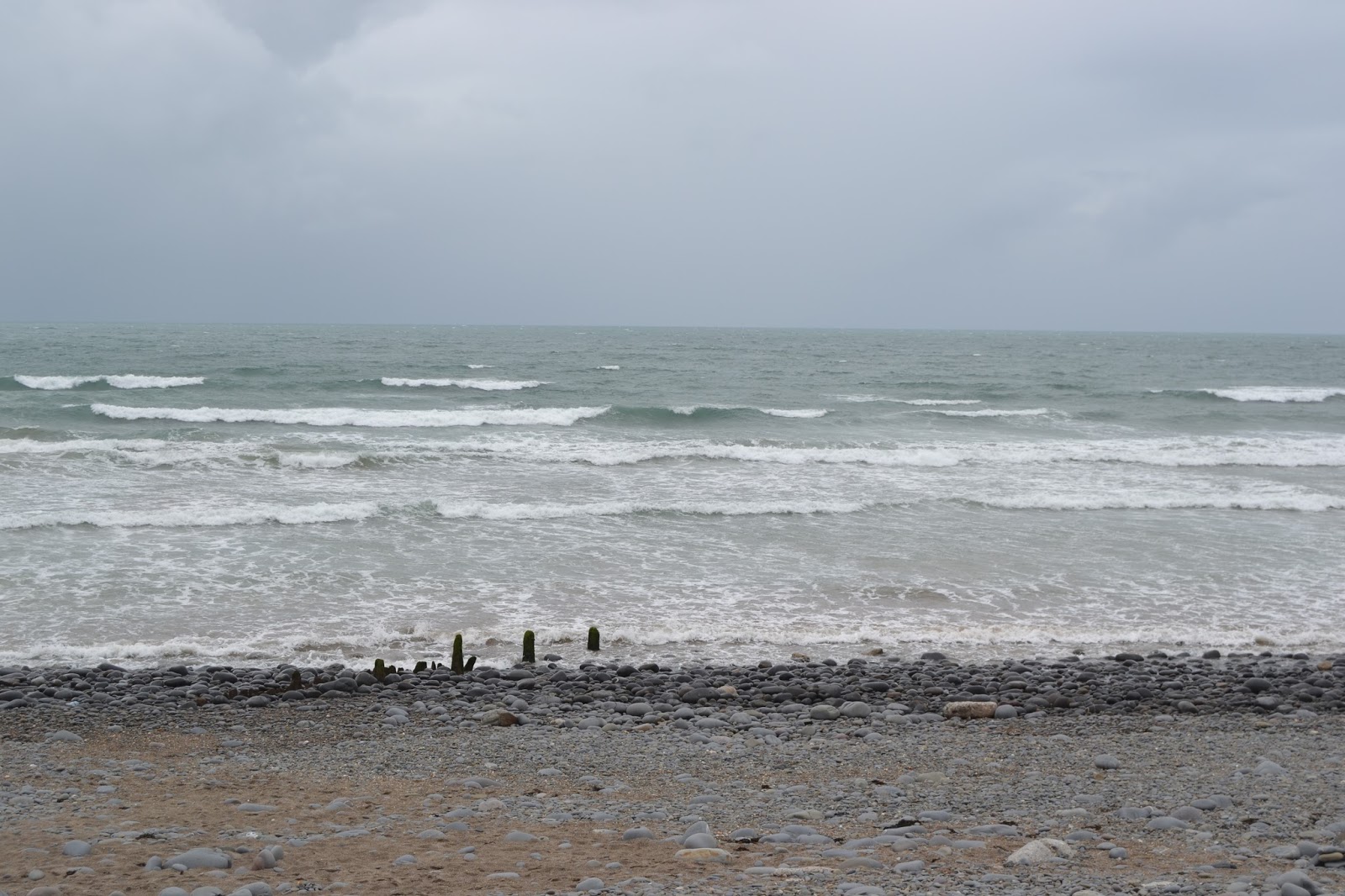
But not today. Today it isn't loud enough; today I cannot lose my petty unease, my navel-gazing. I hunker down in view of sand and sea and pebbles, soft grey boulders reaching into the mist and ringed in white, and I am miserable somehow. My own vitality is not replenished by the life around me, not as I expected and hoped.

 
Then of course I realise that my problem is bigger than the sea, to me - it's a problem of perspective. The ocean is no sticking plaster to the troubled soul. It demands nothing of me and therefore I do not give. I am used to feeling put-upon, in some way like I have to yield and that is how I reach a remedy. Without the demand for me to give myself up, I remain passive.


I now know what it is that I am here for - I want to be obliterated. To fight is to tire, but to surrender is to rest. I have come to the sea to surrender, but she won't accept my terms; I have no choice but to keep fighting, and I'm tired.


The cold, steel-blue waves; the soft green land; the milky pebbles and the unrelentingly grey skies, so vast and yet my spirit is indomitable. And do I want to be indomitable? Today, it seems I do not have a choice. And as I fight my way up the harsh incline of the pebble ridge I remember - what do I remember?

I remember that when I fight, I conquer and I laugh.

Wednesday, 22 July 2015

BIG

BIG

I am the big one.
The big sister.
The tallest.
The towerer-over, still insisting on wearing heels.
The one you tell to sit down
So you don't feel intimidated.

I am the big one.
Big hips.
Jeans-filling.
Swaying, walking, dancing.
The one you can't lend your dress
Because I'll stretch it.

I am the big one.
Big thighs.
Long legs.
Can't fold elegantly into the back of the car,
The one that makes you budge up on the sofa.

I am the big one.
Big ideas.
Talking, laughing, singing.
Asking questions, wanting to know.
The one you think might be more chat than substance.

I am the big one.
Big dreams.
Ambitious.
Up at night writing.
The one who may be better at the theory than the practice.

Big.
I always have been.
I don't mind it.
I don't mind taking up space,
Physical, mental, philosophical.
I don't want to diminish.
I don't want to cower.
I have no plans to apologise.
I have no plans to stop.
This is what I was made to be -
Big.


Friday, 26 June 2015

That's Not You

A while ago I wrote a post under the title 'The Real Me', in which I posited that I wanted to lead what I guess I would term a more authentic or honest life. I also discussed how easy it is to even subconsciously create a public image/personality, and how we structure this to protect ourselves or project an ideal of what we want to be.

Further to that, something I've been thinking about lately is a phrase I've had thrown at me at various points in life, and have definitely heard levelled at others around me: 'that's not you'. From a throwaway comment in the fitting rooms to a statement of surprise in response to an outburst, it's an immediate contradiction that often comes from those closest to us, if it comes at all.

I distinctly remember a number of occasions upon which this little phrase, or words to that effect, caused me to question myself or to feel uncertain. A few times it was wardrobe-related, as inevitably teenage self-expression led to some unusual outfit choices. I would swan into the room in something bright or fitted only to be greeted with a quizzical look and a 'hmmm... that's just not you', quickly followed by me sloping off deflated to get changed. Chances are the people in question felt they were doing me a favour by preventing me from being ridiculous, but I always felt like I had been denied a moment of bravery, and I needed to fit back into whatever mould 'me' was actually supposed to take. As I got older I learned that women used 'that's not you' as code for a lot of things - when they really meant, 'that's not flattering'; 'that's not appropriate'; 'that's too outlandish', they would couch their judgements in the softer tones of 'I don't know, it's just not you, you know?'. I worked in a women's fashion store for two years on and off while I was a student and I saw it so many times, always with the same look of disappointment on the face of the woman in question. Now I'm not saying that it wasn't well-meant or indeed helpful at times, but the primary thing it taught me was, your body doesn't fit, and you can't wear this or this because of it. And if my body didn't fit, then what else about me was in error? How else was I expressing 'me' incorrectly?

'That's not you' isn't just a body-related phenomenon. I was probably more affected by a letter I received just before I got married, from an old friend with whom I had fallen out of touch. They wrote to me out of the blue and I can't recall the full content, but what cut me deeply was this little sentence: 'you're not really that sophisticated, are you?'. I had no idea what they meant. Was I pretending to be sophisticated? Was I coming off as acting out my life, rather than actually living it? I didn't understand. I had no concept of pretence in the way I carried myself at that time; I had developed more confidence and made some different friends, but I hadn't abandoned old friends or principles. Here was this person whom I had known so well and trusted for so long, back in my life after a hiatus in which clearly we had both changed, and their first thought was basically to say to me: 'that's not you.' I didn't get it and I certainly didn't know how to turn around and say, 'actually, yes it is.'

Who decides what is or isn't us? What defines it? Those who know us best ought to be able to tell what is 'normal' for us; when something abnormal happens, the person's behaviour is often described as 'out of character' - it's not a recognisable part of their usual modus operandi. It's been helpful for me at times to be gently contradicted when I've been getting carried away with some behaviour that's actually destructive for me or for those I care about. But on the day-to-day, is there no room for movement, for change? For those of us who sometimes feel like we have to justify or explain any new development in ourselves, it can be exhausting and frankly not always feel worthwhile.

I therefore find myself asking, why do these things get said? It could be just that people find it hard to countenance the new in contrast to the familiar, and that projects itself onto their friends and family as well as their surroundings. Personally I think it's a deeper issue, and it has to do with how we define self in the modern world. In this society we are increasingly free to make wider choices, and the emphasis is so much more on the individual than on community that our understanding of how we function together and inter-relate is constantly tested. I often find myself unsure whether it's right in a given situation to pursue my own good or subdue it for the good of someone else or of a group, when historically a community mindset was the only way civilisations grew and survived. Is it any wonder that when self can be so fluid and so many decisions justified that in the past would have been considered self-indulgent, we face a challenge to who we are? Because it's often easier and clearer to be defined by our differences than by more complex qualities, but those differences can make people uncomfortable.

For me, I know I'm still finding out who I am. It's probably a life-long journey. Some aspects will always be the same and others will change, and I'll do my best to find a balance and hold to the life principles I believe to be important. But when the 'that's not you' challenge gets thrown up and I feel threatened, how do I counter it? Hopefully, with enough grace to keep my friends but enough confidence to keep my individuality. 


Monday, 15 June 2015

All the Things I Thought I Would Have Done

A couple of months ago I made a list of 25 things I wanted to achieve before I turned 27. Perhaps unsurprisingly, considering I am definitely a bite-off-more-than-you-can-chew kind of person, I didn't succeed in getting through them all! There were some extenuating circumstances, but still, I should probably be disappointed with myself, right? I mean what kind of person sets goals and then just completely fails to reach them? Oh wait, that would be me.

The trouble with getting older/growing up, for me anyway, is that I'm still trying to figure out that boundary between flexibility and self-discipline. I know I'm capable of doing a lot, but somehow I still manage to scrape in at the last minute, and it's not a recent development. I was always the last to finish my drawings in art class, taking them home to be completed most of the time; I vividly recall sewing buttons for a craft competition (homeschooler alert!) the night it was due to be handed in for judging, despite having had two months to work on it. My essays were always in on time at uni, but I was forever behind with my reading, cramming my brain full on the train on the way back into Oxford for tutorials. It's like I have all these ideas and no clue how to manage my time around them, or allow for the inevitable interruptions, also known as Life Happening. I make schedules and plans and I can organise to a minute detail; I can pull off a huge party, or food for thirty people in a morning, or a corporate seminar. But when it comes to personal life goals, I always seem to be behind. And what is this self-imposed timetable I am trying to keep up with?

My 27th birthday was last Saturday, the 6th of June. I was discussing this blog post with the husband who cheekily pointed out that it was funny I would be writing about growing up when I'd had a Neverland-themed birthday party, i.e. a celebration based around a boy who never grows up. I hadn't really thought of it that way - I just wanted a pirate ship and bonfire and to be a mermaid, and clearly don't see those why those things should be exclusively for children! - but I had to acknowledge a degree of incidental irony. There I was, swanning around in an elaborate homemade costume and blue wig, garden littered with little bamboo-framed tepees and plastic bows and arrows and glass jars with candles in them, my own personal Neverland - and my list ignored, my goals unreached, and as yet no job to go to the following Monday.

It sounds so irresponsible, so careless when I read it back. I like to think those are terms most people I know would not apply to me. But sometimes you can't control all the cards you're dealt, or you don't know how to play them, or quite simply you get it wrong, and the best you can do is have a few parties along the way while you're figuring it out. It doesn't mean I'm not going to try to improve myself, or hit some of those targets, even if they're late. But at the same time, I've realised there's a lot we hold onto that may not be good for us, it just seemed like a good idea at the time. And that's where I was at when I wrote this.

All the things I thought I would have done
Live in a box
Which I take out and browse sometimes.
It's stored where no one else can find it
Although I let a few close friends have a peek
Once in a while.

Regret sits proudly in one corner,
Relief in another;
Ambivalence and forgetfulness
Can be found at the bottom
If I rummage.

There's a lot of junk
But some things I'm not ready to throw away yet.
It's difficult to detach ambition from sentiment
As they have become tangled over the years,
Mainly with my childhood memorabilia.

Notes from adults who no longer feature in my life,
Opinions lettered in bold ink,
Awaiting trial.
Bright-coloured thoughts wrapped around University papers
And daydreams hurriedly scrawled
In endless notebooks,
None of them full from cover to cover.

I think I keep the box because
I don't know whether I've finished with it.
Whether something I can work with
Will surface from amidst the dross.
Whether my vain hopes
Are extinguished sufficiently
For me to move on,
Find new ones. 

The fact is, I've spent the last few years sifting through those hopes, opinions, daydreams, plans. And I'm willing to bet I'm not the only one who finds themselves looking backwards almost as much as they look forwards, because sometimes it's really hard to tell what's worth holding onto and what isn't.The one thing I am set on is finding a way to prioritise the goals I definitely know are important, because those are the ones I don't want to fail on. As for the rest, I may have to wait and see.